
Peer Review Process
The Kazakh International Journal of Geography and Environment is a double-blind peer-reviewed journal.
All manuscripts submitted to the Kazakh International Journal of Geography and Environment (KIJGE) undergo a strictly double blinded peer review in which the authors’ names are removed for the manuscripts to prepare an anonymous version. Peer review process mainly comprises two steps, e.g., editorial review and blinded peer review.
Articles published in KIJGE endorse COPE guidelines for reviewers. Editors have the foll responsibility for acceptance or rejection when making a decision. The COPE Core Practices on Editorial management is our strict policy in editorial processes and policies.
Below you can see a flowchart about our peer review policy:
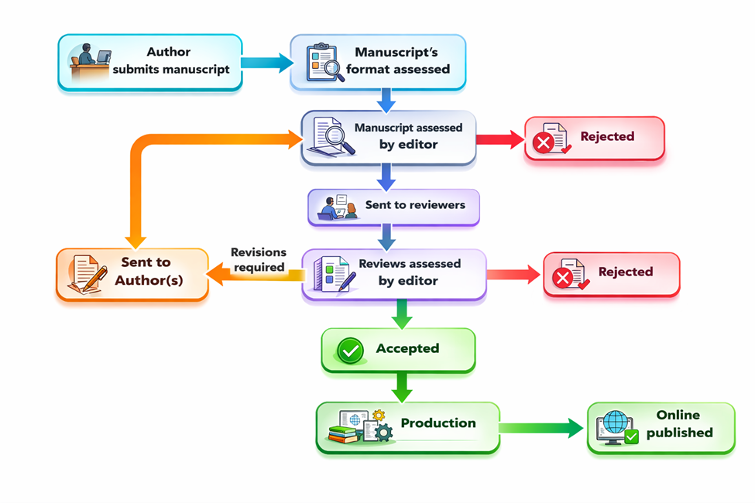
- Submission of manuscript
The corresponding author submits the manuscript to the journal; this is via an online system. The author must use the manuscript's template file.
- Editorial office assessment
The editorial office checks that the manuscript adheres to the requirements described in the Author's Guidelines. The quality of the manuscript is not assessed at this point.
- Editor-in-chief assessment
The Editor-in-chief checks and assesses the manuscript, considering its scope, originality, ethics, and publishability. The Editor-in-chief may decline the manuscript at this point. If the Editor-in-chief deems it appropriate, will assign the article to the Editor(s).
- Invitation to reviewers for the first stage
The editor sends invitations to individuals they believe woold be appropriate reviewers. As responses are received, further invitations are issued, if necessary, until the required number of reviewers is secured– commonly this is two blind reviewers, but there may be some variation between manuscripts.
- Response to invitations for the first stage
Invited reviewers consider the invitation against their expertise, conflicts of interest, and availability. They then accept or decline the invitation to review. Seven days are given to accept or reject the invitation decision. If possible, when declining, they might also suggest alternative reviewers. If the reviewer(s) rejects the invitation, a new reviewer is assigned by the editor. If reviewers accept the invitation, they are given 30 days for evaluation.
- Under review for the first stage
Reviewers are provided with a suitable environment to evaluate the article and are provided with materials that will enable them to evaluate the article upon request. Upon the reviewers’ reasoned request, the reviewers may be given additional time for evaluation. At the end of the period, the reviewers prepare a reasoned report and notify the editor of their decision (acceptance, correction, rejection) via the system.
- Evaluate the reviews for the first stage
The editor considers all the returned reviews before making a decision. Usually, evaluation decisions are coded as accept 3 points, revision 2 points, and reject 1 point. If the average score of the reviewers’ decision is below 1.5, the manuscript is returned to the author. If the average score is between 1.5 and 2, a new reviewer is assigned. If it is above 2, it is sent to the author for revision. If it is 3, the manuscript is accepted and sent to the production.
- Revision required for the first stage
If a decision is "revision required", the decision is communicated to the author together with the reviewers’ reports. The author(s) is expected to examine the reports in detail and make the necessary revisions. The author must indicate any revisions he has made in the revision report. If the author(s) does not make the revision requested by the reviewers, (s)he must explain in detail why (s)he did not correct. The author(s) is given 10 days to make the necessary revisions. The author(s) must upload two files to the system (a revision report and a revised manuscript containing the answer given to the reviewers).
- Response to invitations for the second stage
The revised manuscript is sent again to the same reviewers and the reviewers are given 30 days to evaluate the revision. If one or more of the reviewers states that they cannot evaluate, a new reviewer is assigned.
- Under review for the second stage
Upon the reviewers’ reasoned request, the reviewers may be given additional time for evaluation. At the end of the period, the reviewers prepare a reasoned report and notify the editor of their decision (acceptance, correction, rejection) via the system. If reviewers accept the invitation, they are given 30 days for evaluation.
- Evaluate the reviews for the second stage
The editor considers all the returned reviews before deciding on the second stage. Usually, evaluation decisions are coded as accept 3 points, revision 2 points, and reject 1 point. If the average score of the reviewers’ decision is below 1.5, the manuscript is returned to the author. If the average score is between 1.5 and 2, a new reviewer is assigned. If it is above 2, it is sent to the author for revision. If it is 3, the manuscript is accepted and sent to the production.
- Revision required for the third stage
If a decision is "revision required", the decision is communicated to the author together with the reviewers’ reports. The author(s) is expected to examine the reports in detail and make the necessary revisions. The author must indicate any revisions he has made in the revision report. If the author(s) does not make the revision requested by the reviewers, (s)he must explain in detail why (s)he did not correct. The author(s) is given 10 days to make the necessary revisions. The author(s) must upload two files to the system (a revision report and a revised manuscript containing the answer given to the reviewers).
- Response to invitations for the third stage
The revised manuscript is sent again to the same reviewers and the reviewers are given 30 days to evaluate the revision. If one or more of the reviewers states that they cannot evaluate, a new reviewer is assigned.
- Under review for the third stage
Upon the reviewers’ reasoned request, the reviewers may be given additional time for evaluation. At the end of the period, the reviewers prepare a reasoned report and notify the editor of their decision (acceptance, correction, rejection) via the system. If reviewers accept the invitation, they are given 30 days for evaluation.
- Evaluate the reviews for the third stage and decision
The editor considers all the returned reviews before deciding on the second stage. Usually, evaluation decisions are coded as accept 3 points, revision 2 points, and reject 1 point. If the average score of the reviewers’ decision is below 2,5 the manuscript is returned to the author If it is above 2,5, the manuscript is accepted and sent to production.
- Production & Online published
Layout editors format the accepted article. The formatted article is submitted for author approval. The article approved by the author is published online with a DOI number.